


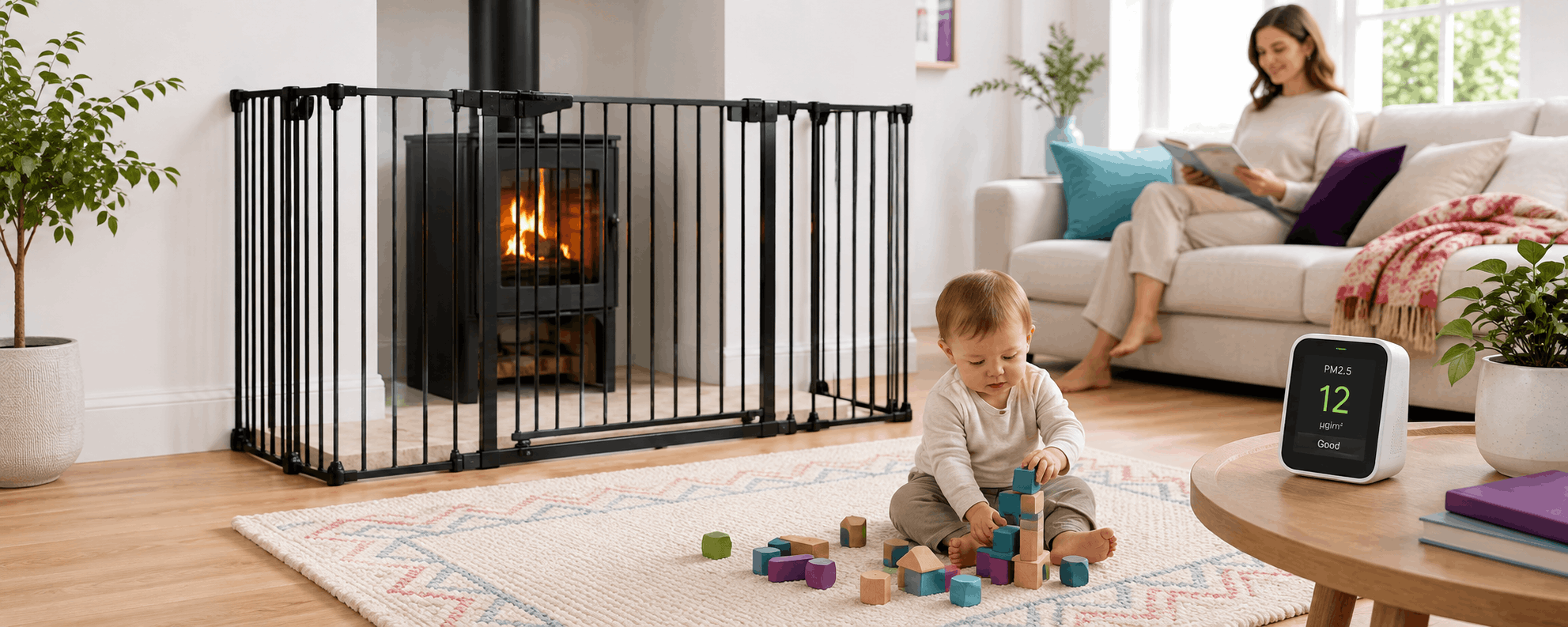
The danger you can see — and the one you can’t
If you have a baby or young child at home, protecting them from a fireplace or stove is an obvious priority. A properly fitted baby fireguard can help keep little hands away from flames, hot surfaces and the hard edges of a hearth.
But once the physical danger is safely behind a barrier, there is another part of fireplace safety that is much easier to overlook: the air your family is breathing.
Open fires, wood-burning stoves and other solid-fuel appliances can affect indoor air quality, and some of the pollutants involved are completely invisible. So while the flames may be safely out of reach, it is worth asking a second question:
What is happening in the air around them?
What poor air quality can do to us — and why babies matter more
Smoke from an open fire or stove contains fine particulate matter, including particles known as PM2.5. These particles are tiny enough to travel deep into the lungs.
Exposure to particulate pollution can irritate the airways, contribute to coughing and breathing problems and aggravate conditions such as asthma. Longer-term exposure to elevated levels of fine-particle pollution is also associated with respiratory and cardiovascular problems.
Poor air quality matters to everyone, but babies and young children deserve particular attention because their lungs are still developing.
Children also breathe more air relative to their body size than adults, and a baby cannot tell you that a room feels smoky, stuffy or uncomfortable. They may spend long periods in the same living space while a fire or stove is burning.
None of this means that having a fireplace or stove automatically makes your home unsafe.
It simply means that, in a home with young children, it makes sense to think about ventilation, fuel quality, appliance maintenance and good combustion alongside the more obvious dangers of flames and hot surfaces.
“But I can’t see any smoke…”
It is easy to assume that if you cannot see smoke in the room, the air must be fine.
Unfortunately, it is not quite that simple.
Fine particles such as PM2.5 are far too small to see individually with the naked eye. A fire or stove can therefore affect indoor air quality without creating an obvious cloud of smoke.
The amount of pollution entering a room depends on many things: the type of appliance, the condition of the chimney, how the fire is burning, what fuel you are using, ventilation within the home and whether smoke escapes when lighting or refuelling.
So “I can’t see any smoke” is reassuring, but it is not the whole picture.
This is particularly relevant with open fireplaces, where the fire is directly exposed to the room.
Open fires and stoves: where pollution can come from
An open fireplace is naturally less contained than an enclosed stove.
Smoke and combustion gases should travel up the chimney, but some can enter the room — particularly when the fire is first lit, when fuel is added, when the chimney is cold or when the draw is poor.
You may notice obvious warning signs such as visible smoke, a persistent smoky smell or soot staining around the fireplace. Smaller amounts of pollution, however, can be much harder to notice.
An enclosed stove generally contains the fire and combustion gases much more effectively, but a stove should not simply be installed and forgotten.
The stove, seals, flue, chimney and ventilation all work together as a system.
Poor installation, damaged door seals, leaking flue connections, inadequate ventilation or deterioration within the chimney can all affect how the appliance operates.
If a stove suddenly becomes difficult to light, regularly sends smoke into the room when the door is opened or starts behaving differently from normal, it is worth finding out why rather than simply accepting it as part of using a stove.
A good stove that is properly installed and maintained can be an excellent source of heat. The key point is that an enclosed flame does not mean you can ignore the chimney, ventilation or maintenance behind it.
Your chimney — and what you burn — matter
A fireplace or stove can only work properly if the chimney or flue is doing its job.
Its role is to create enough draw to carry smoke and combustion gases away from the room. If that draw becomes poor, the entire system may operate less efficiently.
Soot and creosote can build up over time. Birds, nests or debris can cause blockages. Liners can deteriorate. Changes made elsewhere in the house can even affect how air moves through the room and chimney.
That is why regular chimney sweeping is about more than keeping things tidy. It helps remove deposits and obstructions, reduces the risk of chimney fires and provides an opportunity for problems to be spotted.
What you put on the fire matters too.
Wet or poorly seasoned wood tends to burn less efficiently and create more smoke than properly dried wood. It can also contribute to greater deposits within the chimney.
Painted timber, treated wood, household rubbish and materials that were never intended to be burned should not simply be thrown onto the fire. Burning inappropriate materials may release additional pollutants.
A useful rule is simple:
Burn the correct fuel for your appliance, burn it properly, and avoid letting a wood fire spend long periods smouldering inefficiently.
What goes into your fireplace ultimately determines much of what comes out of the chimney.
Ventilation and room temperature
Fire needs air.
In older homes, air often entered naturally through gaps around windows, doors and floors. Modern homes tend to be much more airtight, which is excellent for retaining heat but means ventilation deserves more thought when combustion appliances are present.
If a stove or fire requires permanent ventilation, those vents should not be blocked simply because they create a draught.
Powerful kitchen and bathroom extractor fans can also change the pressure inside a home and, in some circumstances, interfere with chimney draw.
This does not mean leaving every window wide open while the fire is burning. It means ensuring the appliance has the ventilation required for it to operate correctly.
And with a baby in the house, there is another consideration: temperature.
A roaring stove can turn a cosy room into a very hot one surprisingly quickly. Babies are less able than adults to regulate their body temperature, and overheating should be avoided.
Guidance for sleeping babies generally recommends a room temperature of around 16–20°C, and babies should not sleep immediately beside a heater, stove or fire.
During the day you do not need to obsess over a single number, but warmer does not automatically mean healthier.
A simple room thermometer can remove the guesswork.
Carbon monoxide: the danger you cannot see or smell
Carbon monoxide deserves separate attention because it is not the same thing as smoke or particulate pollution.
Carbon monoxide, or CO, is a colourless and odourless gas that can be produced when fuels such as wood, coal, gas or oil do not burn completely.
Exposure can cause symptoms including:
- headache
- dizziness
- nausea
- weakness
- unusual tiredness
- confusion
Significant exposure can become life-threatening.
Because CO cannot be seen or smelled, a properly fitted carbon monoxide alarm is an essential layer of protection in homes containing fuel-burning appliances.
A CO alarm does not replace proper installation, chimney sweeping, appliance servicing or ventilation. It provides an additional warning if something goes wrong.
And one important distinction is worth remembering:
A normal air-quality monitor is not a substitute for a certified carbon monoxide alarm.
Unless a device is specifically designed and approved to detect carbon monoxide, do not rely on it for CO protection.
Can an air-quality monitor help?
One of the frustrating things about indoor air quality is that much of what we are talking about is invisible.
That is where a home air-quality monitor can become genuinely interesting.
Depending on the model, monitors may measure:
- PM2.5 particulate levels
- carbon dioxide (CO₂)
- temperature
- humidity
- sometimes other airborne pollutants
For a home with a stove or open fire, this can give you a useful picture of how conditions change.
You might notice particulate levels increase when the fire is first lit, when another log is added or when the stove door is opened.
You may notice that opening a door or improving ventilation changes readings.
Or you may discover that your apparently cosy living room is actually far warmer or more poorly ventilated than you realised.
Consumer air-quality monitors are not laboratory instruments and their accuracy varies, so they should be regarded as trend-spotting tools rather than medical diagnostic devices.
But they can still answer a useful question:
Is something happening in this room that I cannot see?
Used alongside a proper CO alarm, sensible ventilation and good appliance maintenance, they can provide another useful layer of information.
A simple safer-home routine
Fireplace safety does not have to become complicated.
Think of it as several simple layers of protection working together.
- Use a correctly sized and securely fitted baby fireguard to keep children away from flames, hot surfaces and the hearth.
- Make sure your stove or fireplace is correctly installed.
- Keep the chimney or flue swept and maintained.
- Burn only suitable fuel.
- Use properly dried wood where appropriate.
- Keep required ventilation clear.
- Pay attention to persistent smoke, unusual smells, poor draw or changes in how the appliance behaves.
- Install and maintain an appropriate carbon monoxide alarm.
- Avoid allowing rooms occupied by babies to become excessively hot.
- Consider an air-quality monitor if you want to understand particulate levels, temperature, humidity and ventilation more clearly.
If smoke regularly enters the room, you notice persistent soot staining, the chimney struggles to draw or the stove begins behaving strangely, do not simply learn to live with it.
Have the appliance, flue or chimney investigated by a suitably qualified professional.
So — is your baby in danger?
Having an open fire or stove in your home does not automatically mean your baby is in danger.
A properly installed, well-maintained and correctly used appliance can be part of a perfectly safe and comfortable family home.
The point is simply that fireplace safety goes further than stopping little hands from touching something hot.
The visible dangers are easy to understand: flames, hot stove surfaces and hard hearth edges. A properly fitted baby fireguard helps deal with those risks.
But good fireplace safety also means thinking about the things you cannot see — fine particles, ventilation, chimney performance and carbon monoxide.
Use the right fuel. Keep your chimney maintained. Make sure the appliance is correctly installed. Keep ventilation clear. Use a carbon monoxide alarm. Avoid overheating the room. And if something does not seem right, investigate it rather than ignoring it.
A fire can be one of the most comforting features in a family home.
Protect little hands from the fire — and give just as much thought to the air those little lungs are breathing.