


When you buy a baby gate, it is easy to judge it by how it looks.
It feels strong. The lock seems sturdy. The metal looks substantial. Perhaps the packaging shows a happy toddler standing beside it.
But none of those things tells you how the gate will actually perform when a child repeatedly pushes, pulls, climbs against or investigates it.
That is where EN 1930 comes in.
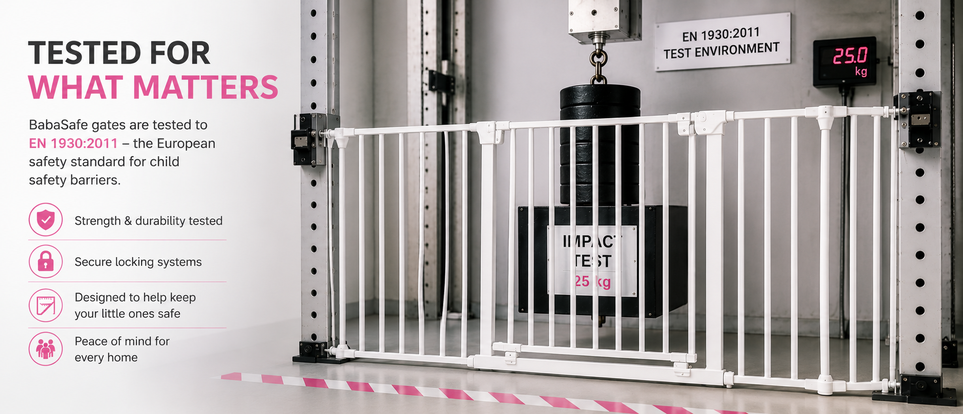
EN 1930 is the European safety standard covering child safety barriers for domestic indoor use. It sets out safety requirements and test methods designed for barriers used to limit a young child's access within the home.
The current standard is EN 1930:2011. In the UK it is published as BS EN 1930:2011, while in Ireland it is I.S. EN 1930:2011. Both are national versions of the same European standard.
For parents, the important point is simple:
A proper child safety gate is about much more than whether it looks strong.
What does EN 1930 actually cover?
EN 1930 applies to child safety barriers intended for domestic indoor use, designed to prevent young children — up to approximately 24 months — from passing through an opening.
That includes the type of barriers commonly used around:
- doorways
- stairways
- restricted areas within the home
- larger openings where a configurable child barrier is required
The standard does not simply prescribe one particular gate design.
Instead, it sets safety requirements and defines tests that a child safety barrier must satisfy.
What does an EN 1930 test look at?
There is much more involved than simply pushing the gate to see whether it falls over.
The standard includes requirements relating to areas such as:
Structural strength
The barrier needs to maintain its structural integrity when subjected to the tests specified by the standard.
A child safety gate is going to be pushed, pulled, leaned against and used repeatedly, so the structure needs to continue doing its job.
Locking mechanisms
The opening and locking system is particularly important.
A gate needs to allow an adult to operate it while making unintended opening by a young child sufficiently difficult.
EN 1930 therefore includes requirements relating to the locking mechanism and the effectiveness of the opening and fixing systems.
Gaps and openings
Children investigate everything.
Their fingers, hands, arms and sometimes heads end up in places an adult would never consider putting them.
The standard therefore examines holes, gaps and openings within and around the barrier to reduce trapping and entrapment hazards.
Height and climbing
A child barrier needs to be sufficiently high and designed in a way that does not unnecessarily help a child climb it.
The standard specifically considers both barrier height and potential footholds.
Edges, corners and projections
A safety product should not introduce an entirely new injury risk.
Edges, projections, corners, snagging points and protruding components are therefore among the construction issues considered.
Impact and repeated use
A child gate does not spend its life untouched.
It is opened, closed, pushed and subjected to impacts.
Testing therefore considers how the barrier performs under forces intended to represent the sort of demands that occur during use.
Materials, marking and instructions
The standard also covers areas including materials, product information, marking and instructions.
Correct installation is an important part of child-barrier safety, so a good product needs more than a strong frame — the user also needs clear information about how it is intended to be fitted and used.
Not every gate is a baby gate
This is an important distinction.
There are plenty of gates on the market that can physically block an opening but were not necessarily designed or tested as child safety barriers.
Pet gates are a perfect example.
A product may be an excellent dog gate without being an appropriate baby gate.
If a gate is marketed simply for pets, you should not assume that it has been tested to EN 1930 unless the manufacturer specifically confirms that the product is also intended and tested for child-safety use.
Some pet barriers use designs such as:
- horizontal bars
- lattice or diamond-shaped sections
- large openings
- structures that can provide climbing footholds
- simple pet-retaining catches
Those characteristics may be perfectly acceptable for containing a dog but inappropriate for a barrier intended to stop a curious toddler.
A gate being strong enough to stop a Labrador does not automatically make it suitable for a two-year-old.
When buying for a child, look for a product specifically designed and tested as a child safety barrier, rather than assuming any metal gate will do the same job.
Traditional cage-style fireguards are different too
The same caution applies around fireplaces.
Traditional cage-style fireguards have been used in homes for generations. Some are substantial products and there is a separate British Standard — BS 8423 — covering fireguards for domestic fires and heating appliances.
But that is not the same standard as EN 1930.
A traditional fireplace cage should therefore not automatically be assumed to be an EN 1930 child safety barrier simply because it is sold as a fireguard or because its packaging shows children.
Some traditional designs may include:
- horizontal or climbable sections
- large mesh or lattice patterns
- freestanding construction
- no permanent wall fixing
- structures primarily designed to provide separation from a fireplace rather than operate as a modern child safety barrier
If the purpose of the product is specifically to create a barrier against a baby or toddler, check what the manufacturer actually states the product has been tested to.
Pictures of babies on the packaging are not a safety standard.
Does EN 1930 mean a gate should have absolutely no movement?
No baby gate should become detached or allow a child to access the protected area, but it is also important to understand the difference between structural failure and normal movement within a product's design.
This is particularly relevant with large multi-panel barriers.
A modular barrier contains articulated joints so that the individual panels can be positioned at different angles.
Those joints are precisely what allow a large gate to be configured around:
- wide openings
- fireplaces
- unusual room layouts
- corners
- different wall positions
An articulated multi-panel barrier will therefore not necessarily feel like one solid welded steel wall.
Some movement or flex can be inherent in the configuration, particularly on very wide installations or where pressure is repeatedly applied sideways.
What matters is that the product is correctly installed, remains securely fixed and continues to prevent the child from accessing the protected area.
With the BabaSafe MultiFit system, the shape of the installation can also influence stability. Angling panels can often create a more stable footprint than positioning a very large number of panels in one completely straight line.
For certain unusual installations, additional floor brackets can also be used where extra stability is required.
Wall-mounted and pressure-fit gates are not the same thing
Another common mistake is assuming every baby gate is suitable for every location.
Pressure-fit gates are enormously convenient in the right situation.
They are held in position by pressure between two surfaces and can often be installed without drilling.
Wall-mounted barriers, on the other hand, are mechanically fixed to the building.
The correct type depends on where the barrier is being used and what the manufacturer says it is suitable for.
This becomes particularly important around stairs, unusually wide openings and configurations where significant forces can be placed on the barrier.
Never assume that because a gate fits physically into an opening it must be suitable for that location.
Follow the manufacturer's intended-use and installation instructions.
What about a baby fireguard?
A multi-panel baby fireguard introduces some additional considerations beyond simply choosing a child safety barrier.
The barrier still needs to perform its primary job:
preventing the child gaining access to the protected area.
But around a working stove or open fire you also need to consider:
- distance from the heat source
- radiant heat
- whether the child can reach through the barrier
- side clearance around projecting stoves
- the position of the hearth
- the hardness and sharp edges of the hearth itself
- where the wall brackets can safely be positioned
This is why a properly configured fireguard should normally protect the whole fireplace area, rather than simply putting a narrow barrier immediately in front of the flames.
You can view our BabaSafe Baby Fireguard range here:
https://www.babasafe.co.uk/baby-products/baby-fire-guards.html
Does compliance make every installation automatically safe?
No.
A safety standard tests the product under defined conditions.
The product still needs to be installed and used correctly in your home.
Even a properly tested barrier can be compromised by:
- unsuitable wall fixings
- incorrect installation
- badly positioned brackets
- leaving the gate open
- furniture placed beside the gate that allows climbing
- installing the wrong type of barrier for the location
- allowing a child to reach a hazard through or around the barrier
- failing to follow the manufacturer's instructions
Think of EN 1930 as an important foundation.
It does not remove the need for parents to choose, install and use the product correctly.
What should you look for when buying a baby gate?
Before buying a child safety barrier, look beyond the photographs and price.
Check:
- Is the product specifically intended for children?
- Does the manufacturer identify the child safety standard it has been tested against?
- Are clear installation instructions supplied?
- Is the fixing method suitable for where you intend to use it?
- Does the design avoid obvious climbing footholds?
- Is the opening and locking system designed for child safety?
- Can you obtain replacement components or support if required?
- Is the manufacturer or supplier clearly identifiable?
And be particularly cautious when a product appears to be primarily a pet gate, decorative barrier or traditional fireplace guard that is simply being used as a substitute for a purpose-designed child safety product.
What standard does BabaSafe use?
BabaSafe child safety barriers are designed around the requirements applicable to their intended child-safety use, including EN 1930:2011 where applicable.
For UK customers, the current national adoption is BS EN 1930:2011.
For Ireland, the corresponding standard is I.S. EN 1930:2011.
The standard covers far more than whether a gate looks substantial. It considers construction, structural integrity, openings, footholds, locking mechanisms, fixing systems, impact and other hazards that are relevant when a barrier is intended for young children.
That is why we believe parents should look for genuine child-safety products rather than simply choosing something that happens to block an opening.
Is EN 1930 being updated?
Yes.
Safety standards do not stand still.
As of 2026, EN 1930:2011 remains the current published standard, but a new revision is progressing through the European standards process.
A draft of the revised standard entered public consultation in 2026. The current BSI development timetable shows the revised standard progressing through comment resolution, with publication presently scheduled for August 2027.
That timetable can still change during the standards-development process.
For consumers, there is no reason to wait for a future edition before buying a safety barrier.
The important thing today is to check products against the current applicable standard, while responsible manufacturers keep an eye on developing requirements and adapt when standards change.
The important thing isn't the number printed on the box
Most parents will never read EN 1930.
And they shouldn't have to.
That is the manufacturer's job.
But knowing what the standard represents can help you make a much better buying decision.
EN 1930 means that a child safety barrier can be assessed against defined requirements and repeatable tests, rather than safety being based simply on somebody saying:
"It feels pretty strong."
When you are protecting a young child, that distinction matters.
Choose a product designed for children.
Install it correctly.
Use it in the location for which it was intended.
And remember:
A dog gate is not automatically a baby gate.
A traditional fireguard is not automatically a child safety barrier.
And a photograph of a baby on the packaging is no substitute for proper safety testing.